Thursday, March 19, 2015

"The New Black perspective....an old black pathology."

TImage result for common imageshe Field Negro education series continues:

Tonight we here from Stereo Williams. (Stereo? Ok then.)

The New Black doesn’t blame other races for our issues.”

So decreed Pharrell Williams when the hit-making superstar spoke to Oprah last summer about the current racial climate in America. In the months following the release of Pharrell’s sugary soul-pop hit “Happy,” the country struggled through a summer that saw a string of high-profile cases involving police killing innocent black citizens. But while speaking to Oprah, and having watched clips of fans paying tribute to his uber-cheerful single, Pharrell decided to advertise a “new” mindset for black people to adopt—one of good ol’ positive thinking.

“The New Black dreams and realizes that it’s not pigmentation: it’s a mentality, and it’s either going to work for you or it’s going to work against you. And you’ve got to pick the side you’re going to be on,” Pharrell said.

His words were laughably empty and insulting to the current climate, the history of black ambition in the face of tremendous cultural oppression, and the reality of institutional racism; but they also represented a vocal cadre of black celebritydom that is calling for the black community to basically “get over it.” With the racial conversation in the national spotlight, stars like Williams, Kanye West, and others aren’t addressing racism in as much as they are deflecting the conversation.

Rapper/actor Common appeared on The Daily Show With Jon Stewart last week to promote his new film Run All Night. Alongside singer-songwriter John Legend, the Chicago rhymer won an Oscar in February for “Glory,” the theme song from the Martin Luther King biopic Selma. While discussing the legacy of the 1960s Civil Rights Movement and the current tensions, Stewart expressed what he’s seen from white people who are resistant to discussing structural racism.

There’s a real vein of anger, like ‘Hey, man—I didn’t have slaves!’” Stewart stated. “But they’re not talking about that, they’re talking about a power structure.”

Common, while not countering Stewart’s statement, offered his perspective on the way to heal wounds that have existed on American soil for centuries.

“We all know there’s been some bad history in our country. We know that racism exists,” the star conceded, before adding, “I’m…extending a hand. And I think a lot of generations and different cultures are saying ‘Hey, we want to get past this. We’ve been bullied and we’ve been beat down, but we don’t want it anymore. We’re not extending a fist and saying, ‘Hey, you did us wrong.’ It’s more like ‘Hey, I’m extending my hand in love. Let’s forget about the past as much as we can, and let’s move from where we are now. How can we help each other? Can you try to help us because we’re going to help ourselves, too.’ That’s really where we are right now.”

“Me as a black man, I’m not sitting there like, ‘White people—y’all did us wrong,’” Common continued. “I mean we know that that existed. I don’t even have to keep bringing that up. It’s like being in a relationship and continuing to bring up the person’s issues.”

Throughout the interview, Common continued to liken American race relations to a difficult romantic relationship (“Let’s get past this”) while echoing comments he’s made both during his Oscar speech in February and in recent interviews. Common wants us all to love each other. His Oscar speech was a sentimental bear hug, the kind of expression of superficial “unity” that tugs at the heartstrings without forcing anyone to think deeper about the specifics of conflict. While turning the Edmond Pettis Bridge—where people marching for the right to vote were beaten by officers of the state—into a symbol for this “unity,” his sentimentality is an easy pill for the Oscar crowd to swallow. “The spirit of this bridge transcends race, gender, religion, sexual orientation, and social status. The spirit of this bridge connects the kid from the South Side of Chicago dreaming of a better life to those in France standing up for their freedom of expression, to the people in Hong Kong protesting for democracy,” Common said at the Oscars.

Also this week, actress Raven-Symone found herself in the midst of another controversy after she defended the racist remarks Univision host Rodner Figueroa made about Michelle Obama. (See HNOTD on sidebar) Figueroa was dismissed from his position on El Gordo y la Flaca following the comment and the ensuing fallout, but when the subject came up on The View, Symone was dismissive of the racial implications.....

The former Disney starlet is guest-starring on hit shows like Empire and black-ish, and she came under fire in 2014 after she announced that she prefers not to think of herself as an African American, but as simply an American.
“I don't want to be labeled gay, I want to be labeled a human who loves humans,” Symone told Oprah last fall. “I’m tired of being labeled. I’m an American. I'm not an African American. I’m an American.

“I don’t know where my roots go to. I don’t know how far back they go... I don’t know what country in Africa I’m from,” she continued. “But I do know that my roots are in Louisiana. I’m an American. That’s a colorless person. We’re all people. I have lots of things running through my veins. I have darker skin. I have a nice, interesting grade of hair. I can connect with Caucasian, I connect with Asian, I connect with black, I connect with Indian. I connect with each culture.”

The idea that black people’s reaction to racism—and not the racism itself—is what must be addressed is an effective distraction that decenters the struggle of black people. It centers the comfort of white people, absolving white supremacy and indicting black rage as “the problem.”

Image result for smiley faceCelebrities like Common and Raven-Symone are but ambassadors of the growing New Black culture that Pharrell became the unwitting poster child for in his now-infamous Oprah interview. “Upward mobility,” sayeth the New Black, “that is the promise of America and because I have achieved—you can, too.” They conveniently romanticize their climb to wherever they are in their lives and careers, telling themselves that they got there via personal drive and ambition that is unique to them. But structural obstacles kept most of their peers stagnant in socio-economic standing; these stars achieved in spite of racism—not because it doesn’t exist. So it is dangerous to put the onus on the oppressed people, as if you believe no one cared to climb the ladder until you came along. Poor public schools and overpriced housing mean that things aren’t really designed for you and your peers to “make it out.” You can’t be “exceptional” without being an exception.

The New Black perspective sounds like an old black pathology. Exceptionalism and respectability have never saved us from the oppressive weight of racism. We’ve always achieved greatness in a country that doesn’t see value in blackness beyond a commodity; maintained dignity in a land that has consistently dehumanized and stigmatized who we are. White supremacy often insists that black people prove themselves exceptional just to share a table with white mediocrity. It is not for black people to extend a hand; it is for the privileged and the powerful to remove their boot from the community’s collective neck. These celebrities seem to be disconnected from the pulse and spirit of many of their peers, but their voices resonate far and wide in pop culture. And more black celebrities should take the struggles of the community at least seriously enough to not offer condescension, rhetoric, and smug dismissals when confronted with the realities of race and racism. Those with the biggest pulpits can’t continue to preach the gospel of positivity, condescension, and denial. It was deflecting when Bill Cosby gave his infamous “Pound Cake speech” in 2004 and it’s deflecting now. It’s an old routine.

When you think about it, there isn’t much “new” about New Blacks at all." [Source]

Actually, Stereo, there is. Their houses are much nicer now.


Wednesday, March 18, 2015

Sorry Martese, your UVA cred is not enough.

Image result for martese uva imageThe Field Negro education series continues:

"Virginia Gov. Terry McAuliffe on Wednesday asked state police to investigate the arrest of a black University of Virginia undergraduate by state liquor agents that left the student bloodied and needing 10 stitches in his head.

McAuliffe was "concerned by the reports of this incident" and wants an independent probe, his office said. University President Teresa Sullivan said in a statement to the campus, in Charlottesville, that she had asked the governor to investigate. Students, faculty and staff "stand unified in our commitment to seeking the truth about this incident," Sullivan wrote. "And we stand united in our belief that equal treatment and equal justice are among our fundamental rights under the law."

Martese Johnson, a junior, was "flung to the ground" by Virginia Department of Alcoholic Beverage Control agents outside Trinity Irish Pub at 12:45 a.m. Wednesday, according to a statement circulated by the student group Concerned Black Students. Johnson is the leadership development chair of the UVA Black Student Alliance, which circulated the statement.

The statement said Johnson did not resist questioning or arrest, but ABC agents pinned him to the pavement with their knees on his back. A photo the group circulated online shows Johnson lying on the sidewalk with his face bloodied as an officer appears to restrain him.

one onlooker repeatedly shouts, "Yo his head is bleeding!" Johnson can be heard yelling, "I go to UVA. You fuckin' racists. ... How did this happen?"

Johnson was charged with public swearing/intoxication and obstructing justice, according to court records. He was treated for his injuries at a hospital and released.

"The uniformed ABC Agents observed and approached the individual after he was refused entry to a licensed establishment," Virginia ABC said in a statement. "A determination was made by the agents to further detain the individual based on their observations and further questioning." ABC officials declined to elaborate.

Charlottesville police arrived just after 1 a.m., "responding to a disorder involving a large crowd after the incident took place," Capt. Wendy Lewis told The Huffington Post. Lewis said the ABC agents had been conducting "some type of operation in our jurisdiction resulting in the arrest and injury" of Johnson. Police dispersed the crowd without further trouble, she added.

Daniel P. Watkins, an attorney representing Johnson, said in a statement that "contrary to early police reports," his client wasn't accused of having a fake ID during the incident. He said ABC agents forced Johnson to the ground prior to handcuffing him, "striking his head on the pavement and causing him to bleed profusely from the gash on his head."

Johnson, a member of the school's Honor Committee and Kappa Alpha Psi fraternity, had recently posted on Facebook about the racist fraternity song in Oklahoma, writing, "This is why things like Black Greek organizations, Black mentorship programs, and Black professional networks still need to exist. If you were wondering..." [Source]

I feel you my young Nupe brother. Keep hitting your books in Wahoo country.

I can only hope that you will be able to live in a world where "color arousal" is not  a thing.

Tuesday, March 17, 2015

Meridian "taxi service".

Image for the news resultThe Field Negro education series continues:
"Police officers in Meridian, Mississippi, were spending so much time hauling handcuffed students from school to the local juvenile jail that they began describing themselves as “just a taxi service.”

It wasn’t because schools in this east Mississippi town were overrun by budding criminals or juvenile superpredators—not by a long shot. Most of the children were arrested and jailed simply for violating school rules, often for trivial offenses.

One 15-year-old girl, for example, was suspended and sent to the Lauderdale County Juvenile Detention Center for a dress code violation. Her jacket was the wrong shade of blue. A boy served a suspension in the juvenile lock-up for passing gas in the classroom. Another landed behind bars because he walked to the alternative school instead of taking the bus.
For many kids, a stint in “juvie” was just the beginning of a never-ending nightmare. Arrests could lead to probation. Subsequent suspensions were then considered probation violations, leading back to jail. And suspensions were a distinct possibility in a district where the NAACP found a suspension rate that was more than 10 times the national average.

In 2012, the U.S. Department of Justice filed suit to stop the “taxi service” in Meridian’s public schools, where 86 percent of the students are black. The DOJ suit, still unresolved, said children were being incarcerated so “arbitrarily and severely as to shock the conscience.”
We should all be shocked.


The reality, though, is that Meridian’s taxi service is just one example of what amounts to a civil rights crisis in America: a “school-to-prison pipeline” that sucks vulnerable children out of the classroom at an alarming rate and funnels them into the harsh world of police, courts and prison cells.
For many children, adolescent misbehavior that once warranted a trip to the principal’s office—and perhaps a stint in study hall—now results in jail time and a greater possibility of lifelong involvement with the criminal justice system. It should surprise no one that the students pushed into this pipeline are disproportionately children of color, mostly impoverished, and those with learning disabilities.
The story of Meridian is more than an example of school discipline run amok. It’s a key to understanding how the United States has attained the dubious distinction of imprisoning more people—and a larger share of its population—than any other country.

It’s one reason why the United States today has a quarter of the world’s prisoners—roughly 2.2 million people—while representing just 5 percent of its total population. And it helps explain an unprecedented incarceration rate that is far and away the highest on the planet, some five to 10 times higher than other Western democracies.

As the managing attorney for the Southern Poverty Law Center’s Mississippi office, I’ve seen firsthand the devastation wrought by the school-to-prison pipeline, and the senselessness of it all.
When SPLC advocates began interviewing children at the juvenile detention center in Meridian in 2009 we were investigating children being pepper-sprayed by guards when they were in their cells and posing no threat. But we kept hearing stories from students who were pushed out of school and into cells for noncriminal, minor school infractions. These stories would eventually spark the DOJ lawsuit and a thorough examination of how the “pipeline” operated in this town.
***
The origins of the school-to-prison pipeline can be traced to the 1990s when reports of juvenile crime began to stoke fears of “superpredators”—described in the 1996 book Body Count as “radically impulsive, brutally remorseless youngsters” with little regard for human life. The superpredator concept, based on what some critics have derided as junk science, is now known to be a complete myth. Former Princeton professor and Bush administration official John DiIulio, the Body Count co-author who coined the term, admitted to The New York Times in 2001 that his theory of sharply rising juvenile violence had been wrong.

But the damage had been done. As these fears took root and mass school shootings like the one at Columbine made headlines, not only did states enact law laws to increase punishment for juvenile offenders, schools began to adopt “zero-tolerance” discipline policies that imposed automatic, pre-determined punishments for rule breakers.

At the same time, states across America were adopting harsh criminal laws, including long mandatory prison sentences for certain crimes and “three strikes” laws that led to life sentences for repeat offenders. The term “zero tolerance” was, in fact, adopted from policing practices and criminal laws that focused on locking up minor offenders as a way to stem more serious crime.

Somewhere along the way, as local police departments began supplying on-duty “school resource officers” to patrol hallways, educators began to confuse typical adolescent misbehavior with criminality. Schools became, more or less, a part of the criminal justice system. With police officers stalking the halls and playgrounds, teachers and principals found it easy to outsource discipline. Almost overnight, a schoolyard scuffle could now land a kid in a jail cell. "[More]

Politico is not one of my favorite online magazines, but this article was on point.

And yes, we need to have this discussion.  

*Pic from Politico.


Monday, March 16, 2015

The real problem with that SAE video.

Image result for negro racist imagesThe Field Negro education series continues.

Britni Danielle, the floor is yours:

"We live in the age of collective condemnation, where one misstep, one clumsy comment, or one racially offensive remark can get anyone 15 minutes of shame. This week, it was members of the Sigma Alpha Epsilon fraternity at the University of Oklahoma who found themselves under the hot glare of the spotlight. After video surfaced of several fraternity members happily singing “You can hang ’em from a tree…there will never be a [n-word] in SAE,” the university severed all ties with the local chapter, and two students were expelled.
Last week, officials in Ferguson, Missouri, were thrust center stage when the U.S. Department of Justice released a scathing report detailing widespread racially discriminatory practices by the city’s police department and court officials. Despite uncovering data that revealed that African Americans accounted for 85 percent of traffic stops, 93 percent of all arrests, and 95 percent of jaywalking stops—while making up 67 percent of the population—some in the media chose to focus on a batch of racist emails sent by city officials instead of highlighting the methodical oppression Ferguson’s residents of color have experienced.

Nowadays, we’re quick to decry blatantly racist episodes. Calling them out allows us to congratulate ourselves for overcoming the bad old days. At the same time, however, we often turn a blind eye to stealthy—and far more damaging—systemic racism. Branding people of color as suspicious, lazy, and unwilling to strive to achieve the American dream can serve to reinforce regressive and oppressive policies.

In order to move forward as a nation and heal the wounds of our racist past and present, we’ve got to go beyond merely playing racism Whac-A-Mole whenever an incident such as the SAE video comes up.

“We think about the issues the wrong way when they arrive. If we keep thinking about them the wrong way, we’re not going to get to the real solutions, because we’re not going after the real problem,” says Jody David Armour, a legal scholar and professor at the University of Southern California, who regularly lectures about the way the law intersects with race and class in America.
“If all we see when we look at the Oklahoma frat case is an isolated incident, and we see another isolated incident in Ferguson, and another isolated incident in Staten Island, and another isolated incident in Cleveland—as long as we see them as isolated incidents, or as incidents caused by a few bad apples, we aren’t getting to the real root causes,” Armour says.

“We are a part of a culture and belief system that depreciates the value of black life. Black lives don’t matter in the general attitudes, beliefs, and values of many Americans,” he says.

That isn’t apparent only in instances such as the killings of Michael Brown and Eric Garner at the hands of police. Consider Hurricane Katrina: Armour notes that the slow response to damage and flooding in New Orleans’ largely black and poor communities led to many deaths: “There wasn’t the same panic of empathy for the Katrina victims” as there was in other disasters that have impacted more white or diverse communities. Armour cites research finding that whites tend to empathize more with those who look like them. While the same is true of African Americans, the unconscious bias of whites is far more damaging because they hold more power and wealth in America (and are still the majority).

“Few black people have power over white people’s lives,” Armour says, pointing to SAE as an example of how power is passed from generation to generation. “Those fraternities feed directly into the Senate and Fortune 500 companies. And those decision makers are white.”

Indeed, SAE counts several members of Congress, business people, and politicians among its ranks, including Senators Max Baucus, Jim DeMint, Mark Pryor, and Johnny Isakson, as well as Nevada’s Gov. Brian Sandoval.

“The people who are wielding control over the American economy, policy, and how it’s going to affect black folks are not black people,” Armour says. “We have Obama in office now, but just having a few token figureheads isn’t the same as having a large number of policy decision makers who empathize with black people.”

In his speech in Selma, Alabama, commemorating the 50th anniversary of Bloody Sunday, a turning point in the civil rights movement, President Obama told the nation we would “do a disservice to the cause of justice by intimating that bias and discrimination are immutable.... If you think nothing’s changed in the past 50 years, ask somebody who lived through Selma or Chicago or L.A. of the ’50s.”

In some aspects, Obama is right; America has changed. Racial segregation and discrimination are outlawed, and incidents of overt racism are quickly condemned as uncivilized. But how much progress have we made as a culture?

In 1963 Malcolm X told reporters, “If you stick a knife in my back nine inches and pull it out six inches, that’s not progress. If you pull it all the way out, that’s not progress. The progress comes from healing the wound that the blow made.”

And as the examples of SAE and Ferguson show, America has yet to heal the wound." [Source]

Before we start talking about "healing" the wound,  maybe we should first try to treat it.

*Pic from crooksandliars.com

Sunday, March 15, 2015

Guns and neighbors.

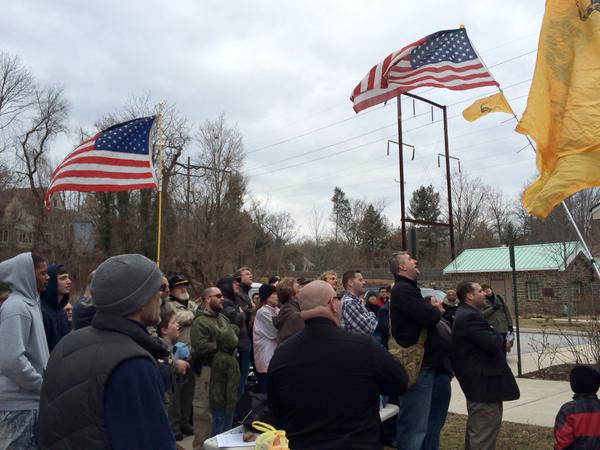
About 70-80 supporters gather to protest Lower Merion gun rule they say is illegal.The poor people of tony Lower Merion, Pennsylvania, must have felt like they woke up in the middle of Texas earlier today.

"Several dozen gun-rights supporters peacefully descended on a Lower Merion park Sunday afternoon, where they protested a local gun ordinance and called on the district attorney to take legal action against the township.

 The township's rule does not ban legal guns from parks, but rally organizers say the ordinance is illegal under Pennsylvania state law. A crowd of about 80 people carried signs, American flags and firearms as they listened to speeches in Bala Cynwyd Park on the cold afternoon. "We're all here because we believe that real patriotism is a willingness to challenge the government when it's wrong," said speaker Steve Piotrowski of Citizens for Liberty.

Joshua Prince, a lawyer, told the crowd that Lower Merion would be sued and asked District Attorney Risa Ferman to bring legal action against all involved.

Two Lower Merion commissioners who attended said the township is not concerned about a lawsuit. The protest did not represent the view of most residents, they said.

"For all intents and purposes, this is an armed occupation here today," said Township Commissioner Brian McGuire, who supports the ordinance and attended the rally to talk to constituents. 

The rally kicked off with the Pledge of Allegiance and a moment of silence for Philadelphia police officer Robert Wilson III, who was killed in the line of duty March 5 when robbers invaded a video game store. The gun event, billed as being family friendly, intended to draw gun-rights supporters from across the state. Organizers said Thursday they were expecting between 280 and 480 to turn out, but the crowd Sunday was substantially smaller.

Gun-rights advocates say the Lower Merion ordinance is illegal under a Pennsylvania law that gives the state jurisdiction over firearms regulation. But gun-control supporters argue that Lower Merion's rule does not fall into any of the categories regulated by that state law. Many localities have repealed their gun regulations after a bill passed last year strengthened state preemption of municipal gun ordinances.

The law, known as Act 192, broadly defines people who can sue localities over their firearms rules to include most state residents and organizations - who do not have to prove they have been personally harmed by the ordinance in question.

Philadelphia, Pittsburgh and Lancaster all left some ordinances on the books and were sued by the National Rifle Association in January.

With a group of state legislators, the cities have brought a separate case against the commonwealth, alleging that procedural maneuvers used to pass the bill were unconstitutional.  

Gun-control advocates think the effort in Lower Merion is part of an attempt by gun-rights supporters to get townships to rescind their ordinances before the court rules on the law, said Shira Goodman, executive director of CeaseFirePA.

"We believe that the law will be thrown out, so we don't feel threatened by a lawsuit," McGuire said. As the national battle over guns has shifted largely to the states, questions like these have become key parts of the debate.

Almost every state has some form of preemption, according to a 2014 analysis by the Carnegie-Knight News21 program. But Pennsylvania's law has drawn national attention from gun-rights and gun-control groups alike.

The NRA called it the strongest statute in the country. On Sunday, the gun-rights demonstrators' presence went unchallenged, though one person shouted "unpatriotic" from the other side of the park, and organizers said they found nails in the street near parked cars. " [Source]

"Guns don't kill people." But neither do laws against controlling guns.

*Pic from Philly.com


Saturday, March 14, 2015

CAPTION SATURDAY.

 
I need a caption for this pic.
 
And what's that old man with the cane doing with a cell phone in  the fifties? 

Friday, March 13, 2015

A hollow victory.

Now this from Arthur Chu:

Image result for images racist of sae"My Twitter feed is celebrating some unusually badass victories going down in the world of civil rights at the moment.
We have a clearly documented case of horrific, vicious racism verbalized as blatantly as you could ask for–brothers of the Sigma Alpha Epsilon gleefully chanting in praise of white supremacy and in mockery of murdered black men. We have an unusually badass university president who, rather than employing the usual stalling-for-time-till-the-story-dies approach of university administrators, expels the two identified ringleaders on the spot and immediately severs the University of Oklahoma’s ties with SAE.

And despite the usual apologetics blaming peer pressure, alcohol and all the other usual white male excuses for white male behavior, it looks like the media isn’t having it regarding 19-year-old Parker Rice, the man caught on camera leading the boisterous “There Will Never Be A N***** SAE” chant. Rice has already lost his admission to OU, and the stain on his reputation will follow him for a long time. As it should.

Meanwhile the long, painful drama in Ferguson, Missouri, has finally achieved something like a positive result–after the grand jury’s infuriating refusal to indict Darren Wilson it seemed like no closure for the Ferguson protesters would be forthcoming. But the U.S. Department of Justice has provided, if not justice for the Brown family, at least validated the Ferguson protesters’ perception of entrenched, overwhelming racial prejudice in the police force that caused the Brown case to explode in the first place.

(We’ve also now seen Thomas Jackson’s resignation as chief of police of Ferguson and the subsequent shooting of two police officers by an unidentified protester or protesters, who, thankfully, are expected to recover.

Image result for images racist of saeJackson’s resignation is good news and to be celebrated. The attempted murder of two police officers is a tragedy and to be condemned. Both events are signs that our culture needs to continue to change, and that we cannot tolerate a return to “normalcy” when normalcy means a world filled with violence and rage.)

Now, finally, someone is losing his job. We don’t have to settle for the anticlimax of Officer Darren Wilson voluntarily retiring in order to “heal the community,” still insisting he did nothing wrong, collecting $400,000 in crowdfunded support along the way.

Now we have a much more satisfying ending to the story, with disgraced city manager John Shaw taking full responsibility for the endless documented abuses of the Ferguson police force and stepping down immediately–only the most recent of five high-profile terminations, including a corrupt judge and three employees–two police officers and a clerk–shown to have passed around racist e-mails on the job. Yes, we all kind of knew that people must’ve been expressing nasty sentiments like that behind the scenes. Yes, we all kind of knew that the city’s “law and order” policies hid race-based motivations.

I should be happy about this news. I should be ecstatic.

So why am I instead kind of anxious and annoyed?....

......The Oklahoma University chapter of SAE does not have a monopoly on toxic racism. And while we could put some of the blame on SAE’s roots in the antebellum South, pillorying SAE specifically won’t fix the fact that de facto segregation is de rigeur in fraternities and sororities across the country. It won’t change the ugly, dehumanizing culture that infects frat life in general, even at fancy Ivy League schools way above the Mason-Dixon line, even in the frats that pledge future senators and Presidents of the United States.

On a larger scale–while the rest of the country is looking down our collective nose at the benighted conditions in Ferguson, the USA as a whole has the highest incarceration rate of any nation in the world, with black men six times more likely to be incarcerated than white men. It doesn’t matter how racist Ferguson is–a single small town in Missouri is nothing more than a tiny blip in this trend.
And wagging fingers about Missouri’s slaveholding Border State past and the dysfunction of backward old St. Louis are a convenient distraction from 12-year-old boys being shot up north in Ohio, and from the organized, militant dysfunction of the police force of the great metropolis of New York City, which, it turns out, also has issues with exploiting its most vulnerable citizens for revenue.
A bunch of fratboys don’t develop an oral tradition of singing racist chants laughing about lynchings without racism being deeply woven into the culture of our fraternities, our schools, our whole society. A single small town doesn’t systematically put its black citizens under apartheid to generate revenue–a town’s officials don’t feel safe joking about its black citizens as subhuman–without racism being deeply woven into our politics, our legal system, our methods of policing.

The urge to find a single scapegoat after a tragedy is overwhelming. And unlike the common use of the term “scapegoat” I’m not saying these people don’t deserve what they get–just as Michael Brown (the other one) deserved to be raked over the coals for the aftermath of Katrina, just as the buck stopped with George W. Bush for the war in Iraq, just as in most complex human tragedies there nonetheless is a specific person who, through negligence or malice, pulled the fatal trigger.

But it’s ridiculous to say that our history would’ve been completely changed if Bush had died or been incapacitated after choking on that pretzel in 2002–a Cheney presidency would’ve been no different. It wasn’t him, it was the apparatus around him, it was the cultural and political and legal mechanisms that got him elected in the first place, and if you replaced him with another guy from the list of Republican candidates he got drawn from it’s hard to see how history would change.

Just as if Parker Rice hadn’t pledged SAE we’d see that same video only with some other fratboy douche leading the chant. Just as if Darren Wilson hadn’t been on patrol that day some other cop would, eventually, have shot some other unarmed teenager (as we can tell by the number of other atrocities that have happened in the past few years across the country). Just as if Capt. Henke and Sgt. Mudd had never been hired there’d be two other civil servants comparing the President to a chimpanzee on government e-mail servers somewhere–and there probably are now, even as I write this.

Just as the Racists Getting Fired Tumblr is ultimately a grandstanding waste of time. Sure, it proves that we’re in an enlightened enough society that people foolish enough to openly broadcast their racism on a social media platform linked to their real identity get fired for it.

So what? There’s millions of other racists with protected Facebook or Twitter accounts, or who are smart enough to use a pseudonym, or who are smart enough to not post racist rants at all, going around doing as much or more damage than some random careless insurance salesman who gets caught by the Internet.

I’m worried about celebrating victory over individual obvious racists not because it’s too harsh on racism but because it’s too soft on racism. It reinforces the idea that racism is an outlier, an aberration, the belligerent drunk shrieking racial slurs, and that once we remove a few bad apples things can get back to “normal.” [Read more here]


Thursday, March 12, 2015

OFF AGAIN.

I am off tonight.

Hold it down for me field hands.

Wednesday, March 11, 2015

Armed with his blackness, and Waka gets blamed for a slur.

Image result for aurora colorado unarmed man shooting imagesIt's not easy to defend the rights of alleged criminals, but I think that we can all agree that everyone has the right  to a trial before he is given the ultimate punishment by those in law enforcement.

Tonight my racism chase takes me to Colorado:

"Police in Aurora, Colorado have now confirmed that they shot an unarmed man in the chest while handcuffing him. The victim’s name is Naeschylus Vinzant. He was on parole since March 2nd, but police say he absconded when he removed his ankle bracelet.

 
When we asked police about the shooting they began listing all of the bad things that Vinzant, 37, had done in his life, as though listing these things would justify their shooting him in the chest while being handcuffed, and while he was unarmed.

At a press conference Monday, police said that “members of the SWAT team attempted to take the subject into custody, at which time one shot was fired and the subject was struck one time in the chest.”

Police Commander Paul O’Keefe tried to emphasize that “officers didn’t know” that Vinzant was unarmed until after they shot and killed him.... Huh?

As the author of the story I quoted from above said:  

"Remember that Aurora is the same town where mass-murderer James Holmes shot and killed 12 people and injured 70 others at a movie theater. Holmes was Caucasian and armed to the teeth. Critics of this most recent police shooting in Aurora note that Vinzant is African American. " [Source]

Yes, but the apologists for violating the rule of law will argue that Vinzent was on parole, and that he was a Negro. Therefore he deserved to die at the hands of the police.

Just one less Negro with a record.

Finally, you gotta love how some white folks treat racism.

For instance, did you know that the ignorant students who went on a racist rant on that bus in Oklahoma are not to blame for their actions? Nope, according to Rush and some white folks in the media, we have rap to blame for that.

Over at Morning Joe they invoked the name of Waka Flocka Flame for crying out loud.

"The concerned parents on Morning Joe found something to be outraged about over the video of SAE frat members engaged in a racist chant: namely the rapper Waka Flocka Flame’s decision not to perform for the fraternity, saying on CNN last night that he was “disgusted” by the video. (Waka Flocka Flame had performed for the frat the previous summer.) Co-host Mika Brzezinski thought Flame should take some responsibility, given that “nigger” appeared in his lyrics.
“If you look at every single song, I guess you call these, that he’s written, it’s a bunch of garbage,” Brzezinski said. “It’s full of n-words, it’s full of f-words. It’s wrong. And he shouldn’t be disgusted with them, he should be disgusted with himself.”

“Popular culture becomes a cesspool, a lot corporations profit off of it, and then people are surprised that some drunk 19-year-old kids repeat what they’ve been hearing,” said Bill Kristol. He added that Tipper Gore “tried to raise this issue, and was widely ridiculed,” referring to the parental advisory labels the future V-FLOTUS enacted after her daughter purchased Purple Rain thirty years ago.

“The kids that are buying hip hop or gangster rap, it’s a white audience, and they hear this over and over again,” Joe Scarborough said. “So do they hear this at home? Well, chances are good, no, they heard a lot of this from guys like this who are now acting shocked.” [Source]

Wrong. They heard and was taught this stuff b the founders of their fraternity long before Waka Flocka Flame was born.

This pic from my twitter fam is on point.

.

Embedded image permalink


Yep.