Showing posts with label MMTC. Show all posts

Thursday, July 16, 2015

Sitting down with a hero, and some harsh words for an organization that currently has none.

The NAACP was just in my hometown for their annual conference, and I am hoping that Mayor Nutter didn't give them the keys to the city. If he did, I would like to formally request to have them back.

Needless to say that I am very disappointed with that venerable organization. I will tell you more about them in a minute. But let me start this post by praising one individual and an organization as well.

I will start with the individual, Feidin Santana.

I met him earlier today in Washington, where he was receiving an award, and he was kind enough to give me a brief interview.

For those of you who were wondering who Feidin Santana is, he is the gentleman who videotaped the police officer executing Walter Scott in North Charleston, South Carolina.

I think I heard it somewhere before, but I was somewhat surprised when he told me that English is not his first language. He was clearly more comfortable speaking in Spanish, and I told him that I spoke a little of his first language, but he was kind enough to talk to me in English.

Image result for feidin santana images    The first thing you notice about the guy is how shy he is. He almost seemed uncomfortable with all the adoration and attention that he was getting.

FN: How  did you keep your cell phone so steady? Especially with all that was going on. Do you have any formal training with videos?
FS: No, I was just in the moment. I was never trained to so anything like this.
FN: What made you decide to start filming in the first place?
FS: I was just watching them, and it didn't look good. I could just tell that it was going to be something serious. 
FN: Did the police try to get the videotape from you?
FS: No, no they didn't.
FN: Given all that has happened would you do it again?
FS: Yes, I would. I don't like to see injustice.

Some other folks were trying to get his attention at this point, so I thanked him for his time and made my exit.

So this 23 year old hero videotapes the horrific incident, tracks down the victim's family, and gives them the videotape. 

This, in spite the fact that he could have sold the video to one of many outlets for money. Or, he could have taken it to the police. Fortunately he was smart enough to know that if he had, he might have never seen it again.

Feidin Santana  is a hero, and he deserves all the recognition that he is getting for what he did on that sad day in early April, 2015.

The organization giving Feidin Santana his award also deserves praise. Thanks to Santana's actions they have actually adopted a resolution  whereby everyone of their members are to "strive to become proficient with the use of mobile devices with video capabilities as a deterrent to voter intimidation and police misconduct."

Five stars for David Honig and the MMTC folks. As far as I can tell this is the first civil rights organization in the country to adopt such a resolution. This is important, because citizens need to understand that under the First Amendment they have every right to videotape police officers when they suspect misconduct when officers are acting in a public space. Just remember to tell them what you are doing, be respectful, and do not in any way obstruct them.

If you follow those rules you will be fine.

Now contrast this with the aforementioned NAACP, who, from all accounts, were given the opportunity to do something similar and refused to do so. Apparently they don't think it's cool for their members to get involved with things such as police misconduct.

Huh???? Hellooooo, you are the NAACP. This is EXACTLY the type of thing that you should be doing.

And we wonder why every day we see another incident like this popping up all over the country.

If organizations like the NAACP won't be proactive and stand up for the victims, who will?

Sadly, the Feidin Santanas of the world don't just grow on trees.


*First pic from nbc.com
**Second pic from thetimes.co.uk, Santana with the mother of Walter Scott.  


Tuesday, August 12, 2014

Who is killing "net neutrality"?

Man this "net neutrality" debate is really on my radar of late.


It all started with what I thought were (and still do) unfair attacks on David Honig and the folks who run MMTC. And so, with his permission, I posted excerpts of our e-mail exchange regarding the push back that he and other organizations were getting from "digital activists" regarding this issue.


The author of the original piece which attacked the establishment civil rights groups and how they are approaching the "net neutrality" debate, reached out to me and subsequently published a response to David Honig's statement for some online news outlets. He claims that Comcast had his article for NewsOne censored after Honig and others protested (a charge which David Honig and MMTC denies) and that this was just another example of the big telecom companies bullying anyone who dares to shine a light to their tactics.


Anyway, in an effort to be totally transparent and fair in this debate, I promised James Rucker, co-founder of the well respected online grass roots group, Color of Change, an opportunity to respond to David Honig as well.


Here goes:


"Hello Field,

Thank you for allowing me to respond to a statement made by David Honig of the Minority Media and Telecommunications Council that you published last week.

In David's statement, he attacked anyone who questioned the influence telecom money has had on the position his organization and other civil rights groups have taken against Net Neutrality, a position that aligns these groups with efforts by Internet Service Providers (ISPs) like Comcast, Verizon and AT&T to undermine an open Internet. But he goes further than that. He says it's insulting — even racist — to ask the questions being posed.

In reality, and David knows this, the circuit of which he is a part is awash in telecom and cable industry money, and all too often the voices of organizations that take industry money end up being aligned with policy positions that benefit the companies providing the money.  
If David acknowledged that this dynamic exists, but disclosed who his backers are in a forthright manner and argued that he himself, his organization, and the civil rights organizations he's organized were an exception to the dynamic, he might have some credibility. Instead, he pretends like this dynamic doesn't exist; according to the Center for Public Integrity, he's been elusive about the millions he's taken from lobbyists, lawyers, and companies with business interests before the FCC; and instead of leading with an argument about how he's right, he (a white guy) accuses those shining a light on these issues of being racist.

Background

First, I want to acknowledge that I know David. Four years ago when I was the executive director of ColorOfChange, I researched the current state of the issue of Net Neutrality in depth (I understood it in the past, given my background as a software developer and architect, and from advocacy work I'd done on the issue in 2006), and ultimately ran a campaign that sought to expose the dynamics coming under scrutiny: civil rights groups (knowingly or not knowingly) taking policy positions that benefit their corporate backers, instead of the communities they represent. As part of the process, I met with David and also talked with the leadership of NAACP, LULAC, NCBCP and other organizations — the context was the previous Net Neutrality proceeding before the FCC at the time. 


 This current debate is an escalation of that previous debate. Back then David organized several civil rights groups to sign onto comments that opposed Net Neutrality, including many of the core organizations currently opposing open Internet protections this time around.  At the time, Honig and other civil rights groups argued they support most open Internet protections but opposed efforts that would ban ISPs from discriminating online (see p.15 of their filing) — i.e. allowing pay-for play fast lanes vs. slow lanes, the prevention of which is a central element of Net Neutrality — because they claim it would hurt low income households. It could have the unintended consequences, they argued, of preventing ISPs from investing in broadband in poor communities. In other words, ISPs would invest in Black communities if they could make more money by discriminating online. It's a theory of trickle-down economics that has been debunked repeatedly. The position MMTC and other civil rights groups staked out at the time perfectly matched the rhetoric and goals of the major ISPs who have backed them. And despite asking, I never heard David, the civil rights groups, or any of the front groups who've pushed these messages, succeed in making a cogent argument to back up their conclusions about how eliminating Net Neutrality would actually result in investment in the communities about which they purportedly care. Four years later, the groups are again making the same arguments, again right in line with the messaging and goals of AT&T, Verizon and Comcast.


Talking with the FCC and Hill staff

Over they years, I've talked with commissioners from the FCC, members of Congress, and their respective staff. There was a time when I thought it was important to explain how the arguments being peddled by groups like MMTC and the major civil rights groups didn't hold water — that they were essentially vacuous arguments that happened to be in service of the interests of the ISPs. I quickly learned that those on the inside — whether on Capitol Hill, at the FCC, or on K Street — knew this. I was told that it wasn't about substance of the arguments; it was about the messenger. Groups like the NAACP, National Urban League, LULAC and others, placed enormous political pressure on the FCC by aligning themselves with the telecom companies. 


 The FCC — especially under Democratic control — doesn't want to be seen as going against the wishes of minority groups. And this is why the approach the telecom industry uses is so effective.  A few weeks ago, I sat down with Tom Wheeler, the current FCC chair, when he visited the Bay Area. When I brought up the dynamic described above — with civil rights groups carrying the trickle-down economics argument of the ISPs — he acknowledged it to be a time-tested tactic, even cracking a joke about the sleight of hand being used by the ISPs to have others carry their water.

The greater dynamic in play
David and MMTC are not alone — they are a part of much larger ecosystem. Hispanic Technology and Telecommunications Partnership (HTTP) has organized civil rights groups in the same manner, but with an emphasis on the Latino community. There are telecom industry consultants and lobbyists who serve on the boards of civil rights organizations and have been shown to use their position to influence. There are media figures that are actually paid by the corporations whose messages they repeat, while not disclosing their connection — just this week, Kristal High, the founder and editor in chief of Politics365, a major MMTC apologist who has trolled the comments section of articles supporting the preservation of Net Neutrality, was exposed for being paid by the ISPs, without disclosing this fact. There are industry front groups (often called astro-turf groups) like Broadband for America — claiming to be community-based and committed to achieving broadband access for communities of color, but in reality they are funded by telecom industry giants and are used to build grassroots support for policies friendly to them.  And, finally, there are paid lobbying firms that are used to go deep into our communities to gin up support for the position of the large telecom players, using the voice of local and state civil rights leaders (this I know because I was approached by a member of a DC lobbying firm that was paid to do this and personally carried out the work). Just search the FCC docket from four years ago for comments filed by MMTC, HTTP, and the organizations they represent, and you'll see the same message being repeated. You'll also see state and local NAACP and Urban League chapters repeating the same industry talking points, deployed by and fed language by DC advocacy firms that specialize in the quid pro quo exchange of money for policy support. So much for free-thinking and independent groups, as David likes to claim.

While this dynamic is understood by those working in the beltway, people outside of Washington remain largely unaware of the relationship between civil rights organizations and the interests of telecom industry players. That began to change in 2011 when Jarrett Barrios, the head of GLAAD, was forced to step down after the LGBT media exposed that the organization was influenced by an AT&T board member to support the AT&T-T-Mobile merger. It was also revealed that the AT&T board member got GLAAD to send a letter opposing Net Neutrality the previous year.

This scandal, for a moment, helped push the conversation about civil rights organizations and telecom companies outside the beltway, with the New York Times editorial page talking about GLAAD, the NAACP, and other civil rights organizations defending policy positions with weak arguments, while receiving big dollars from the companies that stand to benefit.
 
Why this matters

Before finishing, I wanted to say a bit about why Net Neutrality is important to low-income communities, and in particular communities of color. Over the course of history, each new medium to arrive has had the potential to enable everyday people to push back on power, to produce and distribute authentic messages coming from our communities, undisturbed by a corporate filter. And each has repeatedly been killed. For each medium — radio, television, and print — there was the promise of people-controlled media. Yet through media consolidation and barriers-to-entry created by larger corporations to prevent new players from entering, the promise was undone.

The Internet, thus far, has escaped the fate of these other media, largely because of Net Neutrality, which has governed the way content on the Internet is managed. Changing this is in the financial interest of the biggest ISPs (like Comcast, AT&T, and Verizon), but it offers no benefit to consumers. In the current Internet, Field Negro can say what he wants, ColorOfChange can knock media figures like Glenn Beck off a major network, and upstart news organizations can come in and challenge major incumbents — because corporate filters and roadblocks haven't been a part of the landscape when it comes to the core design of the Internet. Similarly, all traffic is prioritized equally — there are no slow lanes for content and application providers without a lot of money, and fast lanes for those with deep pockets who can afford to pay.

The courts have made clear that reclassifying broadband under Title II of the 1996 Telecommunications Act is the only way in the current regulatory landscape for the FCC to be on solid ground in attempting to exercise its authority to protect Net Neutrality rules.   Unlike four years ago, the major ISPs, as well as those repeating their arguments like MMTC, have moved away from straight-up opposing Net Neutrality. Now they say they're for it, but that Section 706 of the Act should be used instead of reclassification under Title II. The problem is that the courts have twice struck down the ability of the FCC to use that path for protecting the Internet, preventing fast lanes for those that can pay and slow lanes for those that can't. And that's the problem with the position of MMTC and the major civil rights groups. They now claim that they support Net Neutrality, but history shows it's likely to be meaningless without reclassification, and that relying on Section 706 cannot stop pay for play.


Anyone who has studied the issue, presumably including David Honig, MMTC, and the civil rights organizations he's organized, understands that.
I think it's fine for corporations to advocate for policies that benefit them — it's their job. However, it's the job of organizations that represent our communities to do just that — represent our communities, not the interests of corporations with which they're financially aligned. These organizations, and the moral authority they claim to have (and should have) cannot be for sale.


The recent rash of articles to which Honig objects serve to strengthen our institutions by ensuring they're accountable. Shedding light on the dynamics in play — dynamics that have the ability to undermine the integrity of our institutions, leaders, and messengers — is critical, because in the end it is our community that is harmed by a lack of accountable leadership. It's why the presence of these articles is a great thing. And that's why David's response to the criticism he has received — that it's insulting, even racist for anyone to raise questions about MMTC's or other civil rights organizations' behavior as described above — lacks credibilty and falls flat. 

James"   ~James Rucker is co-founder and former executive director of ColorOfChange.org, and a former campaign director at MoveOn.org.~


I can't stress enough how important it is that we continue to have this debate.


All of you reading this post will be affected by what ultimately happens with "net neutrality" in one way or another. And it is time that you started paying attention to what is happening in Washington and corporate boardrooms in places like Philadelphia----where Comcast happens to call home.


Get engaged, don't allow just a few people to decide the future of the Internet and how we navigate the information superhighway and close the "digital divide". The older civil rights groups and their leaders like the Rev. Jesse Jackson are speaking out, and as you can tell from the post above, the newer activists are as well.


Learn the issues and decide. That's what I am trying to do, and I feel like I am just scratching the surface.


“One of the issues around net neutrality is whether you are creating different rates or charges for different content providers,” Obama said at a business forum with African leaders.
 
“That’s the big controversy here. You have big, wealthy media companies who might be willing to pay more but then also charge more for more spectrum, more bandwidth on the Internet, so they can stream movies faster or what have you,” he said.
 
“The position of my administration, as well as, I think, a lot of companies here is, you don’t want to start getting a differentiation in how accessible the Internet is to various user,” Obama added. “You want to leave it open so that the next Google or the next Facebook can succeed.”


Ok, so at least I know where the President stands....I think.


*Pics from ColorofChange.org & SFgate.com


Monday, July 28, 2014

The money conundrum.

Right now there is an incredible conference going on down in D.C. It is being led by a man who has devoted his life to making sure that underserved people and people of color have open and free access to the Internet, access to capital, and a voice in the shaping of the telecom industry.


I usually try to go every year, and I will try to make it down tomorrow if my schedule permits.


Anyway, thanks to my relationship with David Honig over the past few years, I have become more familiar with how the FCC works and with all the lobbying and "inside baseball" that goes on as it relates to this particular industry.


It is because of David's influence and connections that I have managed to meet some powerful people in the industry, as well as some brilliant and forward thinking entrepreneurs who are trying to make their mark.


Having said that, I wonder how David and the folks at MMTC will react to the following story? (h/t Dartanyan)


"Last Friday, just before the Federal Communication Commission closed its comment period for its upcoming rule on “network neutrality,” a massive coalition of Asian, Latino and Black civil rights group filed letters arguing that regulators should lay off of Internet Service Providers regarding Title II reclassification and accept FCC Chairman Tom Wheeler’s original plan. In other words, something close to half of the entire civil rights establishment just sold out the Internet.


The civil rights group letters argue that Title II reclassification of broadband services as a public utility — the only path forward for real net neutrality after a federal court ruling in January — would somehow “harm communities of color.” The groups wrote to the FCC to tell them that “we do not believe that the door to Title II should be opened.” Simply put, these groups, many of which claim to carry the mantle of Martin Luther King Jr., are saying that Comcast and Verizon should be able to create Internet slow lanes and fast lanes, and such a change would magically improve the lives of non-white Americans.


The filings reveal a who’s who of civil rights groups willing to shill on behalf of the telecom industry. One filing lists prominent civil rights groups NAACP, the League of United Latin American Citizens, the Urban League, the National Council on Black Civil Participation and the National Action Network. The other features the Council of Korean Americans, the Japanese American Citizens League, the National Black Farmers Association, the Rainbow PUSH Coalition, OCA – Asian Pacific American Advocates, the National Puerto Rican Chamber of Commerce, the Latino Coalition, and many more.


Of course, the groups listed on these filings do not speak for all communities of color on telecom policy, and there are civil rights groups out there that actually support net neutrality, including Color of Change and Asian Americans Advancing Justice. Joseph Torres with Free Press told VICE that communities of color believe a free and open Internet is essential in the digital age, especially when most non-whites do not own radio stations, broadcast outlets or other forms of mass media. “Protecting real net neutrality is critical for people of color because an open Internet gives us the opportunity to speak for ourselves without having to ask corporate gatekeepers for permission,” Torres says.


A number of K Street consultants have helped make this epic sell-out possible.
The Minority Media and Telecommunications Council (MMTC) coordinated many of the participants in the anti-net neutrality filings sent to the FCC last week. Last year, the Center for Public Integrity published an investigation of MMTC, showing that the group has raised hundreds of thousands of dollars from Verizon, Comcast, the National Cable and Telecommunications Association, and other telecom sources while reliably peddling the pro-telecom industry positions. For instance, the group attacked the Obama administration’s first attempt at net neutrality, while celebrating the proposed (and eventually successful) merger between Comcast and NBC.


Martin Chavez, the former Mayor of Albuquerque, now works with a group called the Hispanic Technology and Telecommunications Partnership (HTTP) to corral Latino civil rights groups into opposing net neutrality. Last month, Chavez hosted a net neutrality event on Capitol Hill to call on legislators to oppose Title II reclassification. As TIME recently reported, Chavez is on staff with one of Verizon’s lobbying firms, the Ibarra Strategy Group.


“HTTP is nothing more than an industry front-group that is at best misinformed and at worst intentionally distorting facts as it actively opposes efforts to better serve the communications needs of Latinos,” says Alex Nogales of the National Hispanic Media Coalition, which strongly supports net neutrality. His group has filed its own letter to the FCC.


Still, telecom cash has become a vital source of funding for cash-starved nonprofits. OCA, the Asian American civil rights nonprofit formerly known as the Organization of Chinese Americans, counts Comcast as a major donor and sponsor for its events and galas. Not only did OCA go on to sign the anti-net neutrality letter last Friday, the group wrote a similar filing to the FCC in 2010, claiming absurdly that Asian American entrepreneurs would benefit from having ISPs able to discriminate based on content. Similarly, League of United Latin American Citizens, better known simply as LULAC, has been a dependable ally of the telecom industry while partnering with Comcast for a $5 million civic engagement campaign. Here’s a picture of LULAC proudly accepting a jumbo-sized check from AT&T.


As VICE first reported, telecoms are desperate for third party approval, and have even resorted to fabricating community support for their anti-net neutrality lobbying campaign.


Perhaps the bigger picture here is how so many of the old civil rights establishment have become comfortable with trading endorsements for cash. Verizon, Comcast, AT&T and other telecom companies have donated, either directly or through a company foundation, to nearly every group listed on the anti-net neutrality letters filed last week. We saw a similar dynamic play out with Wal-Mart when the retailer handed out cash to civil rights groups in order to buy support for opening stores in urban areas." [More]


If I didn't know David and how committed he is to civil rights, it would be easier for me to buy into the author's premise that his organization is selling out along with the old civil rights establishment. But I cannot, because I understand that it is far more nuanced than that. Or maybe my judgment when it comes to this issue is clouded by my admiration for this particular individual.
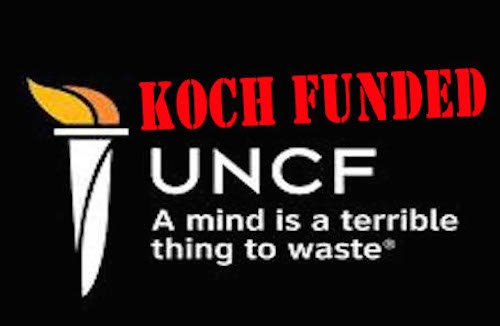
This is all similar to the situation that has manifested itself recently with the UNCF and the money received from the Koch Brothers. Dear UNCF, we are going to give you 25 million reasons why you should like us. It worked. The UNCF took the money, and their leader found a way to justify taking it.


I understand that for some there are no easy answers when it comes to this issue as well. Who can argue against young people of color having the funding to get an education? But then, considering where it's coming from, I could argue against taking it.   


Still, I guess money talks, even if the men who are doing everything in their powers to limit access to the ballot box for people of color are behind the talking.


Of of course, as is the case above with "net neutrality", there were critics. And Harry Belafonte, bless his no quarter giving heart, had some very strong words about the gift:


"They are white supremacists . They are flooding our country with money..."


They are flooding the UNCF with money as well.


Sadly for some, though, they have plenty of it.  And so does Comcast, Verizon, and AT & T.


*Pics from insidermonkey.com and freebacon.com


Wednesday, July 18, 2012

Politics as usual?

It's always nice to be in Washington D.C. and close to the folks calling the shots in these divided states of America. Shout out to David Honig and the MMTC folks for bringing me down. David always brings in the big boys from AT&T, Verizon, Comcast, and Sprint; not to mention a Commissioner or two from the FCC, and he does a hell of a job of making them accountable. You Negroes in America better start paying attention to where the deals are cut, or you will forever be on the outside looking in. These big companies have a lot of money to buy all the influence that they need here in Washington. If folks like David and the rest of the gang at MMTC weren't paying attention for you, it would probably be a lot worse than it already is.

Anyway, here in D.C. both political gangs have been digging in, and it hasn't been pretty.
Of course with all this money and bad blood flowing out there, we  knew that it would get ugly really fast.

Mitt in particular has been in a very bad mood. He is fighting mad at those Chicago boys for going old school on him. Mitt is used to being the HWMIC and he doesn't like being questioned.
He has brought in Rush and the Brietbart crew to help him get personal, and we can expect wingnut guns to keep blazing for the rest of the summer.  Drug use? Commie ties? Citizenship? Oh my! Just how low can we go? And all because we want to see his tax returns. (BTW, the fact that O used drugs as a youngster is probably exactly why he should be president.)

Finally, I would like to thank Sheriff Arpaio for his service to this country. Thank you for all of your hard work in exposing President Obama's "forged' birth certificate there Sheriff, we could not have gotten to the bottom of this without you. Of course, some folks might think that you have a bone to pick with your President.

"America's self-proclaimed toughest sheriff finds himself entangled these days in his own thorny legal troubles: a federal grand jury probe over alleged abuse of power, Justice Department accusations of racial profiling and mistreatment of Hispanics and revelations that his department didn't adequately investigate hundreds of Arizona sex-crime cases."

The good sheriff is a little thin skinned. But, just think, if what he is alleging is true, he will go down as one of the greatest investigators in American history.

Stay cool folks, it is hot out there.


Monday, May 07, 2012

"Incontinent Speeches", and those racist anonymous trolls.

I have been reading and hearing about these empty seats at Obama's kick- off in Ohio, recently. George Will had a snarky remark about O's ego and why there were empty seats at the event. Trudy Rubin wrote about it in her daily Romney Talking Points section, and wingnut radio hosts like Hugh Hewitt cant stop chirping about how his Oness is in trouble because of his poor start.

Anyway, I keep looking at that picture of Flipper's stadium debut, and I can't help but wonder what type of gas they put in the ventilation system in conservative homes. Whatever it is must have them seeing into some type of  parallel universe. Because, unless I am missing something, that bad boy is EMPTY!

Can you imagine if O had opened to a crowd like that?

The sad thing is that the national press is playing right along. I guess they will do anything to not appear to be in the tank for O. In sports we call this a make up call.

Still, if I was a wingnut I wouldn't start measuring the curtains at 1600 Pennsylvania, Avenue just yet. To stay with the sports metaphor: we are just in the first quarter. There is a lot of playing left to do.

Finally, I read an interesting article by Latoya Livingston and Kenneth Mallory from the online MMTC news letter.

They talk about something that we know all too well about on this blog, and what drives it.*

"It happens all too often: We read an interesting article and feel compelled to add our two cents about the topic, so we scroll down to the comments section only to be faced with a barrage of hate. Arguably, most people who write articles would love for their work to be a catalyst for discussion and learning. Unfortunately, many journalists have found the opposite, their words being a springboard for racists and Internet trolls to graffiti their work with odium.

According to digital scholar Vint Cerf, "The Internet is a reflection of our society and that mirror is going to be reflecting what we see. If we do not like what we see in that mirror the problem is not to fix the mirror, we have to fix society." But is this true? Are the vile words of so many on the Internet true representations of American society? And what effect does that have on minority broadband adoption and their desire to allow access to this type of expression into their home?
Several online events seem to call into question Cerf's remarks by forcing many to ask whether the Internet can engender racism not seen during day to day "real world" interactions.
Many have expressed outrage and shock at what they contend are racist comments made online regarding minorities portrayed in and producing popular media. These expressions of hate, from tweets to comments, which would never have been voiced in public or "mixed-company," thrive on the Internet"..[More]

Yes, "But if a tree falls in the forest, and no one is around to hear it, did it really make a sound?" Look, I know they are out there, but I actually think that the racist and ignorant among us do more damage in the real world than they do on the Internet.  

Now once they start acting on their Internet urges we might have a problem.
Still, at least the Internet lets us know that they are out there, and that things aren't always what they seem. 

* Pic from MMTC Broadband&SocialJustice.org