Showing posts with label U.S. Department of Justice. Show all posts

Monday, March 16, 2015

The real problem with that SAE video.

Image result for negro racist imagesThe Field Negro education series continues.

Britni Danielle, the floor is yours:

"We live in the age of collective condemnation, where one misstep, one clumsy comment, or one racially offensive remark can get anyone 15 minutes of shame. This week, it was members of the Sigma Alpha Epsilon fraternity at the University of Oklahoma who found themselves under the hot glare of the spotlight. After video surfaced of several fraternity members happily singing “You can hang ’em from a tree…there will never be a [n-word] in SAE,” the university severed all ties with the local chapter, and two students were expelled.
Last week, officials in Ferguson, Missouri, were thrust center stage when the U.S. Department of Justice released a scathing report detailing widespread racially discriminatory practices by the city’s police department and court officials. Despite uncovering data that revealed that African Americans accounted for 85 percent of traffic stops, 93 percent of all arrests, and 95 percent of jaywalking stops—while making up 67 percent of the population—some in the media chose to focus on a batch of racist emails sent by city officials instead of highlighting the methodical oppression Ferguson’s residents of color have experienced.

Nowadays, we’re quick to decry blatantly racist episodes. Calling them out allows us to congratulate ourselves for overcoming the bad old days. At the same time, however, we often turn a blind eye to stealthy—and far more damaging—systemic racism. Branding people of color as suspicious, lazy, and unwilling to strive to achieve the American dream can serve to reinforce regressive and oppressive policies.

In order to move forward as a nation and heal the wounds of our racist past and present, we’ve got to go beyond merely playing racism Whac-A-Mole whenever an incident such as the SAE video comes up.

“We think about the issues the wrong way when they arrive. If we keep thinking about them the wrong way, we’re not going to get to the real solutions, because we’re not going after the real problem,” says Jody David Armour, a legal scholar and professor at the University of Southern California, who regularly lectures about the way the law intersects with race and class in America.
“If all we see when we look at the Oklahoma frat case is an isolated incident, and we see another isolated incident in Ferguson, and another isolated incident in Staten Island, and another isolated incident in Cleveland—as long as we see them as isolated incidents, or as incidents caused by a few bad apples, we aren’t getting to the real root causes,” Armour says.

“We are a part of a culture and belief system that depreciates the value of black life. Black lives don’t matter in the general attitudes, beliefs, and values of many Americans,” he says.

That isn’t apparent only in instances such as the killings of Michael Brown and Eric Garner at the hands of police. Consider Hurricane Katrina: Armour notes that the slow response to damage and flooding in New Orleans’ largely black and poor communities led to many deaths: “There wasn’t the same panic of empathy for the Katrina victims” as there was in other disasters that have impacted more white or diverse communities. Armour cites research finding that whites tend to empathize more with those who look like them. While the same is true of African Americans, the unconscious bias of whites is far more damaging because they hold more power and wealth in America (and are still the majority).

“Few black people have power over white people’s lives,” Armour says, pointing to SAE as an example of how power is passed from generation to generation. “Those fraternities feed directly into the Senate and Fortune 500 companies. And those decision makers are white.”

Indeed, SAE counts several members of Congress, business people, and politicians among its ranks, including Senators Max Baucus, Jim DeMint, Mark Pryor, and Johnny Isakson, as well as Nevada’s Gov. Brian Sandoval.

“The people who are wielding control over the American economy, policy, and how it’s going to affect black folks are not black people,” Armour says. “We have Obama in office now, but just having a few token figureheads isn’t the same as having a large number of policy decision makers who empathize with black people.”

In his speech in Selma, Alabama, commemorating the 50th anniversary of Bloody Sunday, a turning point in the civil rights movement, President Obama told the nation we would “do a disservice to the cause of justice by intimating that bias and discrimination are immutable.... If you think nothing’s changed in the past 50 years, ask somebody who lived through Selma or Chicago or L.A. of the ’50s.”

In some aspects, Obama is right; America has changed. Racial segregation and discrimination are outlawed, and incidents of overt racism are quickly condemned as uncivilized. But how much progress have we made as a culture?

In 1963 Malcolm X told reporters, “If you stick a knife in my back nine inches and pull it out six inches, that’s not progress. If you pull it all the way out, that’s not progress. The progress comes from healing the wound that the blow made.”

And as the examples of SAE and Ferguson show, America has yet to heal the wound." [Source]

Before we start talking about "healing" the wound,  maybe we should first try to treat it.

*Pic from crooksandliars.com

Thursday, February 05, 2015

The feds are looking at the boss of New Jersey, and Piyush gets a picture.

A couple of republican governors are on my mind tonight.

The first one is the governor right across the bridge from me in New Jersey.

He might want to reconsider that run for president as he seems to have some bigger issues right now.

"Federal law enforcement officials have launched a criminal investigation of New Jersey Gov. Chris Christie and members of his administration, pursuing allegations the governor and his staff broke the law when they quashed grand jury indictments against Christie supporters, International Business Times has learned.

Two criminal investigators from the U.S. Department of Justice on Wednesday interviewed the man who leveled those charges, Bennett Barlyn. He was fired from the Hunterdon County prosecutor's office in August 2010, and subsequently brought a whistleblower lawsuit against the Christie administration, claiming he had been punished for objecting to the dismissal of the indictments of the governor's supporters for a range of corrupt activities.

Barlyn told IBTimes that he met with the federal investigators at his Pennsylvania home for more than an hour on Wednesday afternoon. He said they specifically focused on why Christie’s then-attorney general, Paula Dow, had moved to expunge the indictments. The investigators are examining what state and federal laws may have been broken in the process. Barlyn said the investigators appeared to be at an exploratory stage, with no certainty that criminal charges would ultimately be filed. The meeting followed a June letter to Barlyn from New Jersey’s U.S. Attorney, Paul Fishman, instructing Barlyn to be in touch with his office’s investigative team about the case.

The New Jersey U.S. Attorney’s office declined to comment. Christie has denied any involvement in Barlyn's termination, while maintaining that he does not even know the men and women he has been accused of aiding. The governor's office did not respond to a request for comment.

The case centers on rural Hunterdon County, a sparsely populated patch of New Jersey along the Delaware River. There, Barlyn claims, then-county Sheriff Deborah Trout ran her office like a private fiefdom, hiring her friends without respect to their experience, and without initiating proper background checks as mandated by state law.

Barlyn’s office began probing Trout in 2008, eventually convening a grand jury that returned 43 indictments against her, Undersheriff Michael Russo and investigator John Falat Jr. The Christie administration then intervened, took over the prosecution and -- in an extraordinary step -- moved to have the grand jury indictments overturned, saying they were legally and factually deficient. When Barlyn raised objections, he was fired.

The expunging of those indictments, Barlyn's termination and his allegations that Christie’s administration quashed the case to protect the governor’s supporters were first aired in a lengthy story in the New York Times in 2013. Several members of the grand jury told the Times that the evidence supporting the indictments was strong, and that overturning them seemed motivated by political considerations."   [Source] 

It seemed like only yesterday we were talking about Bridgegate,

The other governor comes from one of my favorite states, Louisiana.

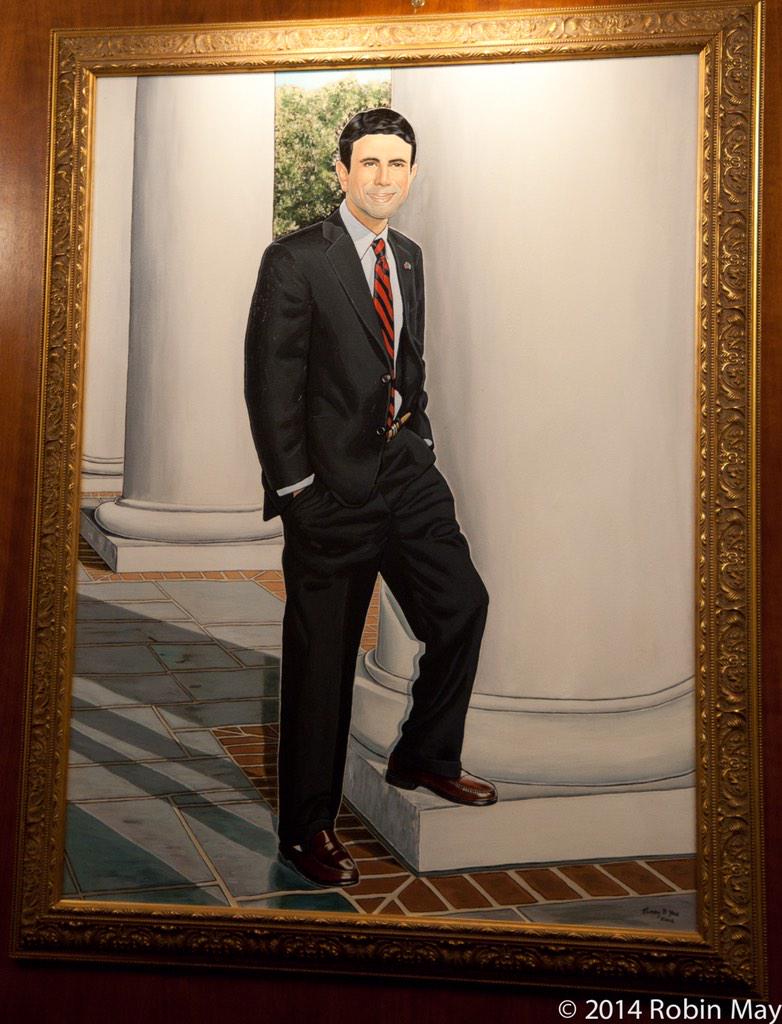
View image on TwitterI must admit that when I first heard the story about Bobby Jindal's portrait I was ready to trash the man for the incredible amount of self-hate that he seems to have stored up.

I mean who would go out of his way to have a portrait of himself done in such away if he didn't wish he looked different than he does?

Well, as it turns out, someone gave the governor the portrait as a gift. (Or so he says) And according to his office his official portrait is much closer to his....well.....Indian roots.

I suppose this portrait says more about the people of Louisiana than it does their governor. I suspect that this is how some of them want him to look.

Poor Bobby. If only he really looked this way, we might be calling him President Jindal.

But, alas, he does not.

Sadly, what you get is  a man who is confused about who he really is.  And a man who went as far as changing his religion to appeal to a very white, very Christian, GOP base.

"The man born "Piyush" who adopted the name "Bobby" as a child has been taken to task by fellow Indian-Americans for forgetting his ethnic and religious roots. And he's come under heavy fire for refusing to back down from claims that in the West, "non-assimilationist Muslims establish enclaves and carry out as much of Sharia law as they can."

An MSNBC contributor was banned from the network after claiming Jindal was "trying to scrub some of the brown off his skin."

Jindal has defended his personal decisions by citing his parents' own immigration story from India.
"My dad and mom told my brother and me that we came to America to be Americans," he said in a speech last month in London. "I do not believe in hyphenated Americans."
 
Whatever, Piyush.
 
 
*Christie pic from dailypaul.com