 The Field Negro education series continues.
"Slaves, obey your earthly masters with respect and fear, and with sincerity of heart, just as you would obey Christ. " ~Ephesians 6:5 ~
"Donald Mathews explicated the connection between white supremacist lynchings and the religious milieu that existed among whites in the South in his article “The Southern Rite of Human Sacrifice” (2000). He concluded his manuscript by writing, “The primary focus has been to suggest a connection between the South’s most dramatic act of brutality and the pervasive drama of salvation preached from pulpits throughout the region.”
The connections Mathews highlights are certainly intriguing and insightful, but whatever the connections between lynchings and white Southern religion, the primary aim of lynchings and other forms of anti-Black violence can be simplified. Lynchings were about reinforcing white economic power and social control over Black lives. Ida B. Wells, the most renowned anti-lynching activist during the height of the lynching era, explains in her autobiography (Wells 1970) that lynching was simply “[a]n excuse to get rid of Negroes who were acquiring wealth and property and thus keep the race terrorized and ‘keep the nigger down.’” In other words, lynchings were conducted to stymie Black economic progress and to instill fear in affected Black communities.
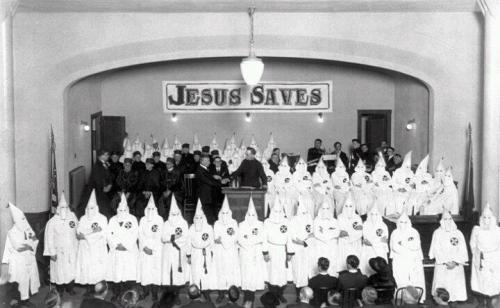
Economic power and social control are also implicated as the rationale for white extra-legal violence in one of the most influential movie pictures in the early 1900s: The Birth of a Nation. Released in 1915, the film depicted the Klan redeeming the white South from the clutches of “Negro rule” (Blum 2007). A white Jesus appears at the end to bless the machinations of the Klan, which, at first glance, dovetails nicely with Mathews’s thesis. But the appearance of white Jesus is not for the purposes of sanctifying a lynching or accepting a blood sacrifice. Instead, the white Jesus appears in order to bless the rise of the Ku Klux Klan which has wrested control of the South away from the depicted predatory black beasts and placed them under the control and authority of white men (Hutchinson 1996).
Near the end of the film, the horse-riding Ku Klux Klan sweeps into town to save white families besieged by Black Union army veterans (portrayed by a combination of Black actors and white actors in blackface). Klan members align themselves on their horses in the fashion of a blockade in order to prevent Black men from voting (as women were not yet allowed to vote). By blocking Black men from voting, white Klan members were solidifying and securing white political power for future generations. When the white Jesus appears on the screen, it is a divine seal of approval for white power and control.
Whereas Mathews describes how religion in southern white society helps to contextualize and explain lynchings, it may be that the reverse is also true. Perhaps it is truer that lynchings helped reveal the real religious impulse of white lynchers. In his book The Cross and The Lynching Tree, James Cone elucidates the connection between lynching and racial power even further:
Lynching was the white community’s way of forcibly reminding blacks of their inferiority and powerlessness. To be black meant that whites could do anything to you and your people, and that neither you nor anyone else could do anything about it.This is illuminated further in Edward Blum’s W.E.B. Du Bois: American Prophet, where Blum discusses “white supremacist theology” and highlights a phalanx of white racist authors, clergy, and novelists who fashioned racism into virtual articles of faith at the beginning of the 1900s. He notes:
They had tried to sanctify the segregation of African Americans and widespread racial violence by characterizing “Negroes” as soulless beasts. …whites crafted a variety of religious and theological rationales for structures of exploitation…. By 1900, white supremacist theology was firmly rooted in white American mainstream culture.Hence, white supremacist theology was rendered even “crafted” to justify racial violence, domination, and exploitation as “lynchings became acts of Christian service, black men became devils incarnate, and white women became angels”' (Blum 2007). [More]
What do you think?
*Pic from bytheirstrangefruit.blogspot.com